Report from Hamburg: EPATH 2025
Just a reminder that paid subscribers see all news posts one week early and help contribute to pay our authors and make TPATHs work possible.
So, to start with a disclaimer. I am not a scientist and have no academic background in medical, psychological sciences or such. I am just a stubborn enthusiastic activist who is interested in these conferences,
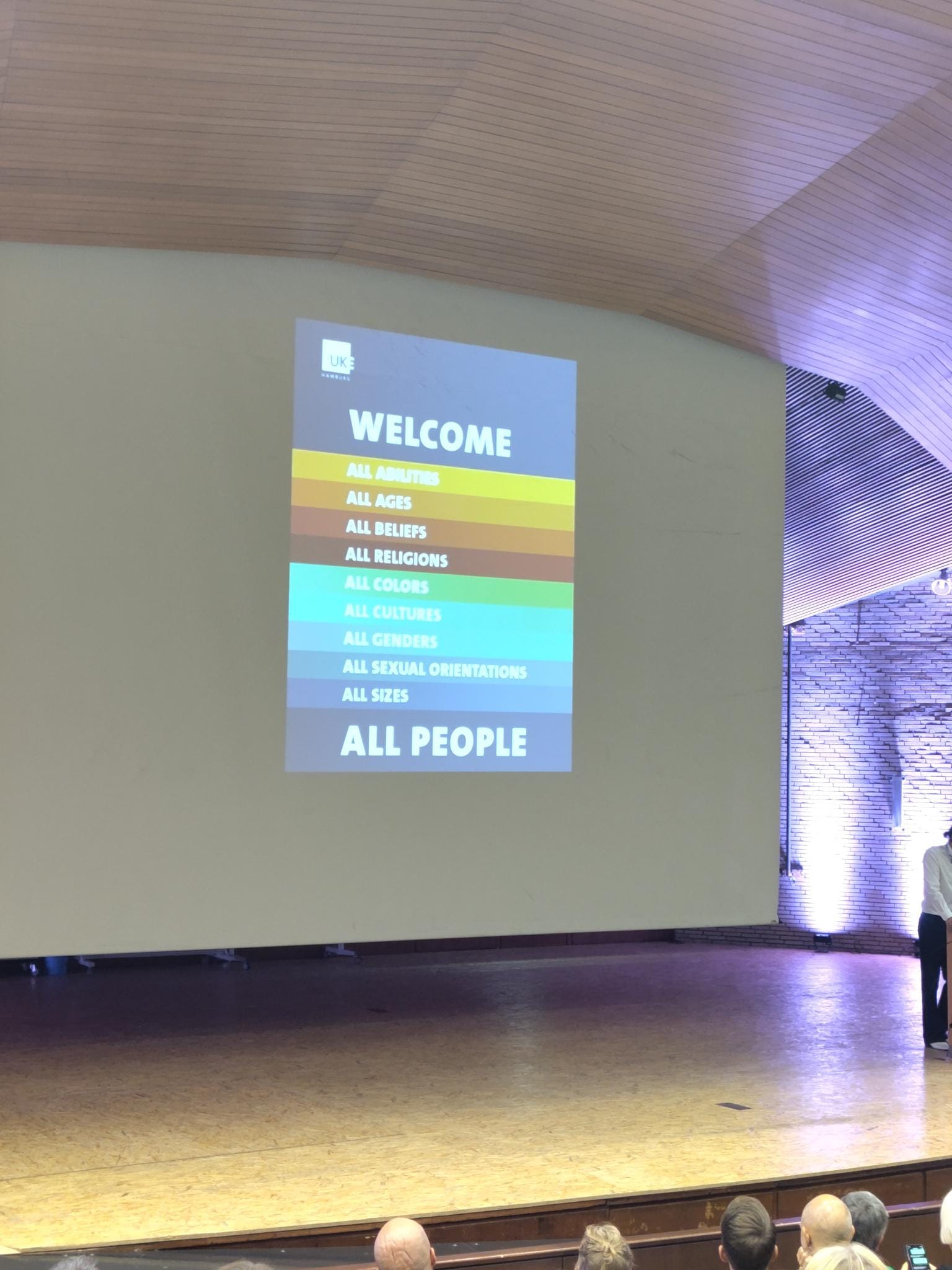
EPATH 2025 was the 5th edition of this conference. It ran from September 2nd to 5th in Hamburg, Germany and was entitled “Cutting through the noise: evidence-driven transgender care.” I had the pleasure and privilege of attending on behalf of TPATH. Visiting there was more positive than I had thought it would be. Progressive science has trickled down to the trans medical world – at least in Europe. At WPATH 2016 that was definitely not yet the case. At the opening session all genders and all sexual orientations were welcomed. I don’t remember if kink or BD/SM were mentioned as sexual orientations. Presumably not. Asexual/aromantic (Ace/Aro) were though. Still, there are far more gender orientations and sexual identities than these scientists are aware of or validate.
Also, EPATH strongly took a position against all the trans hate, with the conference chairs Annelou de Vries and Timo Nieder warning against the “so called gender critical movement [that] targets not only trans people, but also all the institution of democracy that protect individual and collective human rights… “The fight for trans rights is also a fight for racial, social, gender and economic justice. This co-coordinated global movement has to be challenged by us.¨ I must say I find that pretty explicit, and equally bold. This set the tone for the rest of the conference.
I attended a workshop/presentation by young Flemish (Belgian) voice trainers/therapists who were working with Belgian Transgender and gender diverse (TGD) clients. The session explored needs and experiences of TGD ppl in Belgium. I must say I am not aware of recent voice coaching techniques, but I was happy for the emphasis on individual needs. As expected, research on voice coaching training for TGD individuals across the broad spectrum of gender identities is pretty incomplete.
Elements like age, group/sub-culture affiliation and preferences were taken into account. As it was focused on youth, games were part of the coaching, even with VR masks/helmets/glasses. These voice coaching students are also fans of group work. In other research on outcome predictors in Gender Affirming Voice Care for Trans women, younger and more musical people score better in femininity. A randomized trial also showed that intonation training has a clear beneficial effect for transmasculine people. The group work has a beneficial effect on the young trans people as it brings them together and thereby lessens their isolation during the dreaded waiting times for medical assistance that has such a negative effect on their life
I also attended a workshop on trans refugees that was led by the French organization, FLIRT-Front Transfem, together with Trans Europe (TGEU). They talked about France and, as expected, trans refugees are not taken seriously there, with many trans people of color recounting deeply troubling experiences from doctors, up to being told “you’re insulting France”. Having a white/cis person with them improved the visit. An intersectional approach in care that accounts for more than just gender identity and centers trans empowerment is urgently needed.
Another presentation I attended was “Flipping the examination room,” which was given by a couple of students from Vienna. These students investigated those who treat and pathologize us. Their main question was, how is trans sensitive treatment understood by health care providers and how does this compare to TINQA (Trans, Intersex, Nonbinary, Queer, Agender; everybody who is not cis and endosex) people´s expectations? They did this through institutional ethnography, community-based participatory research, grounded theory and attending several trainings for health care providers (HCP). The researchers found that healthcare providers often practice benevolent pathologization of their trans patients, and that they argue that this is necessary to convince states to fund trans-affirming care. Patients were throughout depicted as vulnerable by the healthcare providers, though this really underscores how they are made vulnerable. On the other hand, the health care providers interviewed frequently experience feelings of vulnerability, mostly when expectations around their experience and authority are confronted with gaps in knowledge, societal norms, or lack of experience. When this happens, it is up to their patients to ‘calm’ them. The researchers advocate for a more ethical and sensitive treatment approach in TINQA healthcare that allows healthcare practitioners to acknowledge their insecurities and give adequate, not special care.
The Amsterdam University Medical Center team had a poster around their issue with mental health care for nonbinary and genderqueer clients. They are open about the existence of sociopolitical pressure influencing mental health care providers’ confidence and clinical certainty, as well as influencing these providers’ unfamiliarity with this ‘new’ phenomenon. What it shows though is that they don’t accept the people’s self-identification as a given. Given that they have worked for more than ten years with nonbinary and genderqueer youth and adults, I find that insulting. To them this is still a new phenomenon. Of course, narratives shift, but if they shift that much in their experience, maybe they are not equipped to work in this field? They keep on working from a (benevolent?) pathologizing gaze.
Of course, the conference gave ample attention to medical developments in the field of gender affirming hormonal care and surgeries. However, my attention is more on the sociopolitical and legal fields, as they constitute a large part of how developments can or cannot find their way in daily care work.
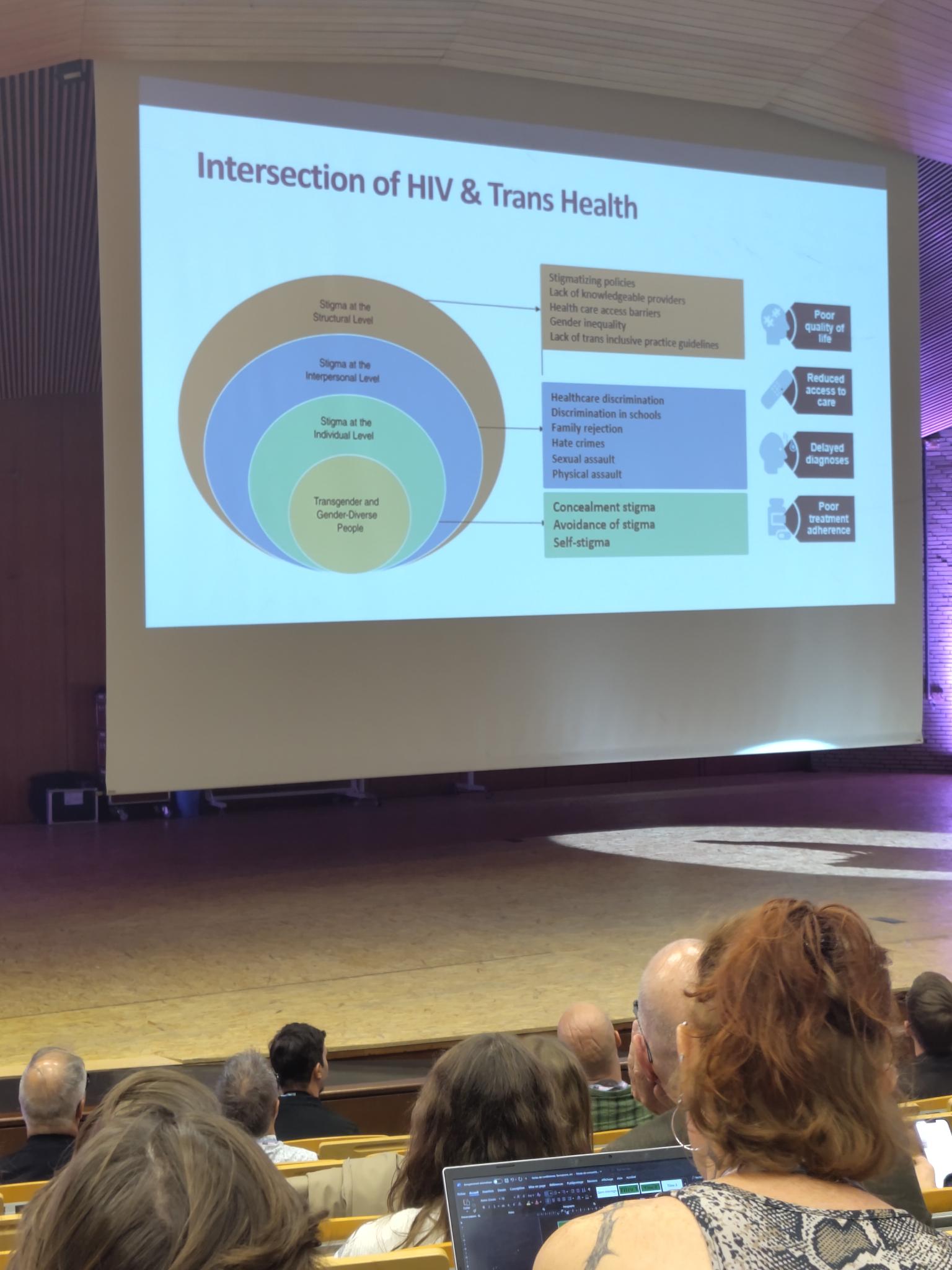
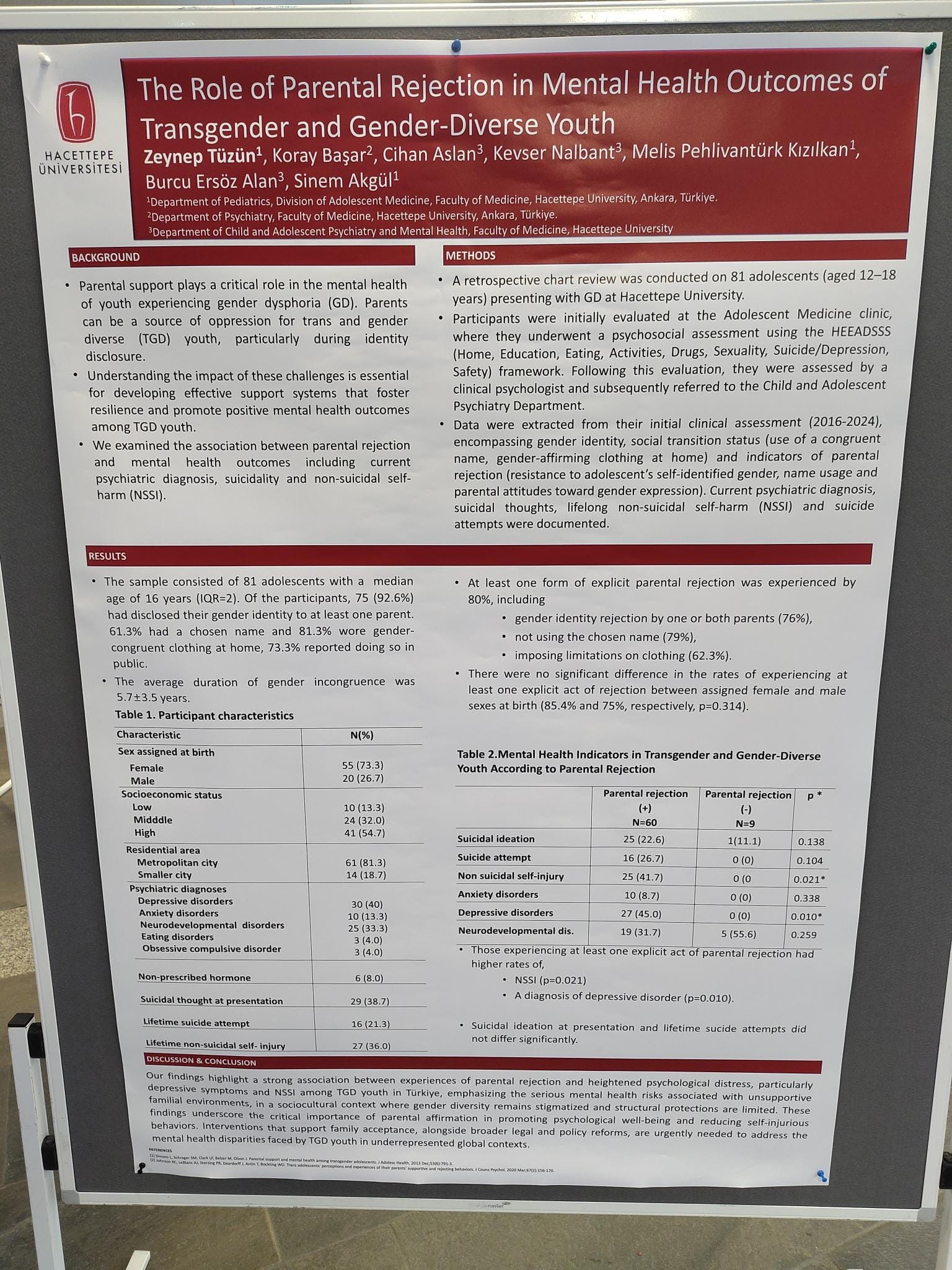
Picture of two presentations from the conference. One is a slide on the intersection of HIV & trans health, while the other is on the impact of parental rejection on trans youth's mental health.
Also from the Amsterdam UMC team comes a presentation “The weight of waiting: the temporal politics in GAMC for youth.” Waiting isn’t empty time, waiting is delay, emotional labor, uncertainty. It is slow violence and cruel optimism, something that should give you joy becomes an obstacle. Not surprisingly, those on the waiting list suffer in many ways.
We know that all the waiting protocols for care seeking adolescents are nefarious, potentially lethal even. But what makes them happy? What engenders gender euphoria? That is the question Judy Alan Richter and their team, from Freie Universitat Berlin, asked. Some of their results were presented at EPATH; for instance, that the youngsters were very happy discovering their pronouns, even if nobody used them yet! The adolescents describe the emotions that came with gender euphoria as excitement, longing, sometimes ambiguity as affirming, and they expressed this physically through screaming and laughing. In response to the question “what triggers gender euphoria in trans adolescents,” the researchers shared that support, acceptance, passing, coming out, affirming language, and being asked about pronouns were all factors. The biggest positive overall factor for the youth was being accepted. Binary identified youth indicated that passing was very important, while nonbinary youth gave a higher weight to pronouns.
Having been present at most European *PATH conferences since 2016 and still following research highlights, I was able to listen to some interesting results. The tone has definitely shifted over the years, with the influx of researchers and doctors who are trans/non-binary themselves, so that Nihil Nobis Sine Nobis starts to become a reality.
My big issues with this and other conferences still sticks though: they refuse to see what we have often been screaming from the roofs and fighting for in doctors’ offices for years on end until they can translate it into research and methodological rigor. It first needs to be processed in a palatable way before they finally accept it. We’re still a long way from trans medical paradise, but we are also gaining more success.